

Anyone who has run a multi-day corporate conference in Melbourne knows the silent truth nobody puts on the program. The success of the event often depends less on the keynotes and more on how cleanly delegates move through the city. Brilliant speakers can’t fix a delegation that arrives 45 minutes late because half the group was stuck waiting for a rideshare that never came. Furthermore, sponsor VIPs notice every detail. International guests judge the entire visit by their first 30 minutes on the ground. Behind every smooth Melbourne conference lies a transport coordination plan most attendees never see.
This playbook is that plan. It draws on what actually works for events of 20, 50, or 200+ delegates moving through Melbourne, and what consistently breaks down without proper coordination.
Phase One: Setting Up the Coordination Framework
Before delegate names ever appear on a list, three foundational decisions shape everything that follows. Each one is small but compounds across the event.
The first is choosing a single transport partner rather than multiple providers. Splitting bookings between rideshare apps, taxi accounts, and chauffeur services creates inconsistency that magnifies over time. Conversely, a single coordinated group corporate transport in Melbourne arrangement keeps every vehicle, driver, and arrival point under one operations centre.
The second is locking in the venue arrival rhythm. Melbourne’s major conference venues each have distinct drop-off windows, valet capacities, and pedestrian flow constraints. Furthermore, peak arrival times tend to cluster within tight windows, meaning 50 delegates arriving within the same 15-minute slot can overwhelm a venue if not sequenced properly.
The third decision is assigning a single point of contact between the conference organiser and the chauffeur operator. Last-minute changes happen on every event. Centralising decisions through one channel prevents the 4 AM messaging chaos that breaks otherwise solid plans.
Phase Two: Airport Arrivals and the First Impression Test
The conference begins long before delegates walk into the venue. For interstate and international guests, the experience starts at Tullamarine.
A coordinated Melbourne airport corporate pickup handles several issues at once. Flights are tracked in real time, meaning vehicles are already in motion before the plane finishes taxiing. Drivers hold professional name placards inside the terminal rather than waiting curbside. Luggage is handled discreetly. The transition from arrivals hall to vehicle takes minutes rather than the 30 to 90 minute friction that defines unmanaged rideshare arrivals.
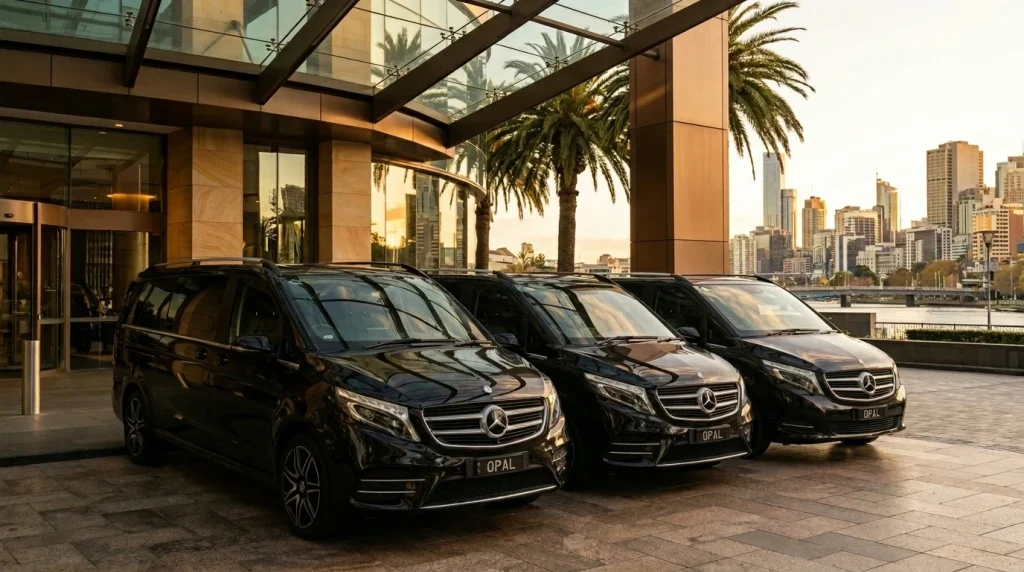
For sponsor-led VIP guests and senior executives, a polished VIP chauffeur in Melbourne protects the first physical handshake of the conference relationship. Furthermore, for clients arriving with media or recognition concerns, celebrity chauffeur Melbourne standards provide additional discretion through pre-arranged side-entrance pickup zones at Tullamarine.
For delegations arriving together, group sequencing matters. A trained operations team coordinates vehicle staging so the lead executive doesn’t wait while junior colleagues are loaded. Equally, it prevents the awkward arrival pattern where three vehicles pull up to the same hotel entrance simultaneously and create unnecessary congestion.
Phase Three: Conference Day Transfers — The Hidden Logistics
Once delegates are settled, day-to-day conference transfers become the real test of coordination. Here, three categories of movement dominate every event.
Hotel-to-venue transfers during morning peak hours. Without coordination, 80 delegates from five different hotels can produce chaos. A properly coordinated conference transport in Melbourne arrangement instead sequences arrivals by hotel and seniority, with each vehicle pre-staged at the correct entrance.
Inter-session and offsite movements. Many modern conferences include site visits, sponsor lunches, networking dinners, or partner brand activations. Each of these creates a mini-event of its own, with its own transport demands. Furthermore, the timing windows are usually tight, often within 30 to 60 minutes.
Sponsor-led VIP programs, where premium guests require entirely separate transport arrangements that don’t blur with general attendee logistics. For these, dedicated corporate event transfers in Melbourne typically run on a separate scheduling stream, with continuity of vehicle and driver across the entire visit.
Phase Four: Late-Night and Post-Event Transfers
Most coordinators plan brilliantly for arrivals and underplan departures. This is one of the most common failure points in Melbourne conference logistics.
After-dinner returns to hotels routinely overlap with general taxi demand, leaving delegates exposed to long waits in the rain or cold. Pre-booked group chauffeur transfers eliminate this entirely. Vehicles stage discreetly nearby during sessions and collect guests within minutes of the event concluding.
Equally, late-night sponsor dinners and awards nights tend to run late. A flexible group transport partner adjusts in real time rather than rigidly enforcing booking windows.
Phase Five: Departure Coordination
Conference final days are quietly the most stressful for transport coordination. Delegates leave at different times, head to different terminals, and often have meetings to attend before catching flights.
A coordinated departure schedule handles this by mapping each delegate’s flight time, terminal, and hotel checkout in a single matrix. Furthermore, group sedans and Mercedes V-Class vehicles are staged accordingly across the morning to clear hotels efficiently.
The final impression matters as much as the first. A polished, well-paced departure leaves delegates remembering the conference for what it delivered rather than the chaos of how it ended.
What Separates Professional Coordination From Improvisation
After running coordinated group transfers across hundreds of Melbourne conferences, certain operational markers consistently distinguish smooth events from troubled ones.
Real-time fleet visibility, where the coordinator can see every vehicle’s status across the day. Pre-event briefing sessions, where drivers are given the guest list, venue details, and individual VIP notes in advance. Consolidated invoicing across the entire event, simplifying finance reporting. Single-point operations support, available 24 hours through the live event. And most importantly, vehicle continuity, where the same driver remains with the same guest across multi-day visits whenever possible.
Genuine concierge car service in Melbourne is built around exactly these markers, which is why corporate event coordinators increasingly choose pre-booked specialist providers over fragmented app-based bookings.
How to Set Up Coordinated Group Conference Transfers
The setup is straightforward. Provide the conference schedule, delegate list, hotel allocations, and any VIP designations. A tailored coordination plan is then built around the specific dynamics of the event. To discuss tailored arrangements or set up a corporate conference account, simply request a quote or contact the team through the contact page.
A conference is only as polished as its weakest moment. With proper group transport coordination, that weak moment never has to be the curb.